Your estimated 1RMs
| Lift | Your set | Est. 1RM | Total load |
|---|---|---|---|
| Muscle-up | +10 kg × 3 | +18.5 kg | 93.5 kg |
| Pull-up | +30 kg × 5 | +47.5 kg | 122.5 kg |
| Dip | +45 kg × 5 | +65 kg | 140 kg |
| Squat | 120 kg × 5 | 140 kg | 140 kg |
Muscle-up, pull-up and dip 1RMs show the added weight, as competitions score them. Total load includes your bodyweight.
How a streetlifting total works
In streetlifting, the bar lifts are scored by the weight you add: the plates on your belt for the muscle-up, pull-up and dip. The squat counts the whole barbell. Your total is the sum of your best lift in each.
- Bar lifts count added weight. A 75 kg athlete who pulls up with 47.5 kg on the belt scores 47.5 kg, not 122.5 kg.
- The squat counts the bar. A 140 kg back squat adds 140 kg to the total.
- Formats differ. Some meets contest only the pull-up and dip, others add the muscle-up or the squat, so the calculator shows both a pull-up + dip total and the full total.
- Bodyweight matters. Divide the total by your bodyweight to compare yourself with lighter and heavier lifters.
The four lifts, and how to test them
Use the same standard in training that a judge would use, or the estimate will be higher than what you can actually lift.
Weighted muscle-up
Start from a dead hang, pull over the bar without a kip and finish with straight arms on top. Muscle-ups are the most technical lift, so test with 1 to 3 reps rather than higher sets.
Weighted pull-up
Start from a dead hang with straight arms and pull until your chin is clearly over the bar. For a detailed estimate with rep-max loads, use the weighted pull-up 1RM calculator.
Weighted dip
Lower until your shoulder is at or below the top of your elbow, then lock out. For loads and a weekly plan, use the weighted dip 1RM calculator.
Back squat
Squat with the barbell on your back to a depth where the hip crease goes below the top of the knee. Enter the bar weight; your bodyweight is not added.
How to get accurate estimates
- Test with 2 to 6 reps on the pull-up, dip and squat, and 1 to 3 on the muscle-up.
- Go close to failure. A set stopped with three or four reps left will under-estimate your max.
- Weigh yourself the same day. A 1 kg error in bodyweight is a 1 kg error in every bar-lift result.
- Test fresh. Use the first hard set of each lift, not a set at the end of the session.
- Count only competition-standard reps. Kips, shallow dips and high squats inflate the estimate.
Streetlifting calculator: common questions
How do I calculate my streetlifting total?
Add up your best lift in each discipline: the added weight on the muscle-up, pull-up and dip, plus the full bar weight on the squat. Enter one hard set of each into the calculator and it estimates every 1RM and adds them for you.
Why does the calculator count my bodyweight on pull-ups, dips and muscle-ups?
Because you lift it. A 75 kg athlete doing pull-ups with +30 kg moves 105 kg, and the 1RM formula has to be applied to that total load. The calculator then subtracts your bodyweight so the result is the weight on the belt, which is what streetlifting scores.
Can I calculate a weighted muscle-up 1RM?
Yes. Enter your added weight and reps for the muscle-up. Muscle-ups are technical, so estimates from 1 to 3 strict reps are much more reliable than from higher sets.
What if I only compete in the pull-up and dip?
Set the reps for the muscle-up and squat to 0. The calculator then shows only your pull-up and dip, and the pull-up + dip total is always shown separately as well.
Which formula should I use?
Epley is a good default for sets of 2 to 10 reps. If you are unsure, choose the average of Epley, Brzycki and Wathen. Whichever you pick, use the same one every time so your estimates are comparable.
How often should I test my streetlifting total?
Every four to eight weeks for true maxes. In between, enter your best hard sets into the calculator to follow the trend without the fatigue of frequent max attempts.
How do I track my streetlifting lifts over time?
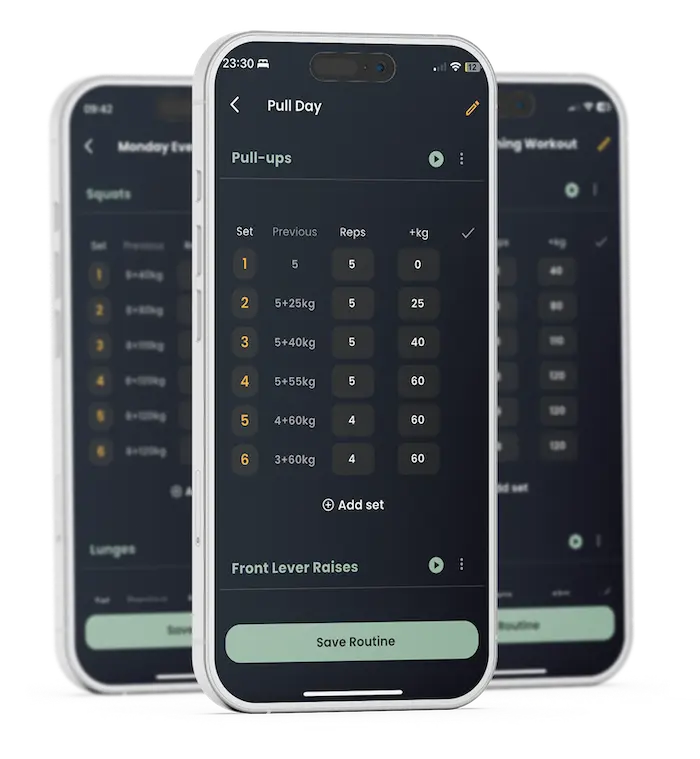
The free Calitracker app logs reps and added weight for every set of muscle-ups, pull-ups, dips and squats, and tracks your estimated 1RM for each lift automatically on iOS and Android.
This calculator gives estimates for training purposes and is not medical advice. Competition rules differ between federations, so check the rulebook of your meet.