Rep maxes & training loads
| Rep max | Added | Total | % of 1RM |
|---|---|---|---|
| 1RM | +45 kg | 120 kg | 100% |
| 2RM | +37.5 kg | 112.5 kg | 94% |
| 3RM | +34 kg | 109 kg | 91% |
| 4RM | +31 kg | 106 kg | 88% |
| 5RM | +28 kg | 103 kg | 86% |
| 6RM | +25 kg | 100 kg | 83% |
| 8RM | +19.5 kg | 94.5 kg | 79% |
| 10RM | +15 kg | 90 kg | 75% |
Percentages are of the total system weight, not of the belt weight. A minus sign means that rep max is below bodyweight, so it would need band assistance.
Formula comparison (added-weight 1RM)
How to use your weighted pull-up 1RM
Your result is the weight to hang from the belt for one all-out rep. Use it to pick training loads from the rep-max table, and treat it as a target for your next max attempt rather than a guarantee.
- For a max attempt, open a few kilos under the estimate, then go up in small jumps.
- For strength work, use the 3RM to 6RM rows and stop one or two reps short of failure.
- For volume work, use the 8RM to 10RM rows for sets of 6 to 8.
- For percentage-based programs, take the percentage of your total 1RM, bodyweight included, then subtract your bodyweight. With a 120 kg total at 75 kg bodyweight, 80% is 96 kg, so you load +21 kg. Taking 80% of the +45 kg belt weight instead would be +36 kg, which is really 92.5% of your max.
How to increase your weighted pull-up 1RM
To increase your weighted pull-up 1RM, train the lift heavy two or three times a week in sets of 3 to 6 reps, stop most sets one or two reps short of failure, and add weight in small steps of 1.25 to 2.5 kg. Support it with higher-rep volume, rows and grip work, and re-test every four to eight weeks.
1. Earn the belt first
A common guideline is 8 to 10 strict pull-ups from a dead hang before adding weight. Below that, more bodyweight volume builds your max faster than a belt does.
2. Lift heavy, but leave a rep in the tank
Strength is built with heavy sets of 3 to 6 reps. Grinding every set to failure is not required, and it costs you quality on the sets that follow. In an 8-week study of trained men, the group that ended each pull-up set early improved their 1RM, while the group that pushed deep into fatigue did not improve.
3. Add weight in small steps
Use progressive overload with a rep range. Pick a load you can do for 3 sets of 3, build it to 3 sets of 5 over the following sessions, then add 1.25 to 2.5 kg and start again at 3. Small plates matter here, because 2.5 kg is a big jump relative to what is on the belt.
4. Keep a volume day
Heavy triples alone stall quickly. A second session of lighter sets of 6 to 8 reps, or bodyweight sets, builds the muscle and work capacity that heavier singles depend on.
5. Train the weak links
- Off the bottom: scapular pull-ups and paused reps from a dead hang.
- At the top: chin-over-bar holds and slow negatives with your working weight.
- Back and arms: heavy rows and curls for extra pulling volume without more hanging.
- Grip: weighted dead hangs, so your hands never limit the lift.
6. Manage your bodyweight
Every kilo of fat you carry is a kilo that is not on the belt. Losing fat while keeping your strength raises your added-weight max directly, and stronger pullers tend to carry more lean mass. Avoid crash diets around a max attempt, since they cost strength too.
7. Make every rep the same
Start from a dead hang, get the chin clearly over the bar, and do not kip. Keep the weight hanging close to your body so it does not swing. Reps that would not count in a competition should not count in training.
8. Protect your elbows and recover
Weighted pulling loads the elbows and shoulders hard. Warm up with bodyweight sets and two or three lighter weighted sets, increase load gradually, and take a lighter deload week every four to six weeks or whenever your elbows start to ache.
9. Test rarely, estimate often
True max attempts are tiring and risky to repeat. Test every four to eight weeks, and in between enter your best set of 3 to 6 reps into the calculator to check the trend.
A simple weekly plan for a bigger weighted pull-up
Loads refer to the rep-max table in the calculator. Rest three to four minutes between heavy sets.
| Day | Sets × reps | Load |
|---|---|---|
| 1 · Heavy | 4 × 3–4 | Your 5RM |
| 2 · Volume | 4 × 6–8 | Your 10RM |
| 3 · Optional | 3 × 5–8 | Bodyweight |
Finish days 1 and 2 with rows and a grip exercise. When you complete every set at the top of the rep range, add 1.25 to 2.5 kg the following week. Every fourth to sixth week, cut the sets in half, then re-test and update your numbers.
Why your bodyweight counts
On a pull-up bar the plates on your belt are only a fraction of what you lift. A normal one rep max calculator does not know that. Enter 25 kg for 5 reps and it returns about 29 kg. For a 75 kg athlete the real load was 100 kg, and the realistic max is about +42 kg. That is a gap of more than 10 kg.
It also explains why weighted calisthenics numbers move with the scale. The same pulling strength is +45 kg at 75 kg bodyweight and +47 kg at 73 kg, so log your bodyweight alongside every test.
How to get an accurate estimate
- Test with 2 to 6 reps. Estimates get rougher above 10 reps, and bodyweight-only sets of 15+ give a ballpark number at best.
- Go close to failure. A set with 0 to 1 reps in reserve beats a comfortable set with a guessed RIR of 4. Lifters commonly underestimate how many reps they had left.
- Weigh yourself the same day. A 1 kg error in bodyweight is a 1 kg error in the result, and the belt and chain count as added weight.
- Test fresh. Use the first hard set of the session after a warm-up, not the fourth set after fatigue has set in.
- Count only strict reps. Half reps and kipped reps inflate the estimate and set you up for a missed attempt.
Weighted pull-up 1RM: common questions
How do I increase my weighted pull-up 1RM?
Train the lift heavy two or three times a week, mostly in sets of 3 to 6 reps that stop one or two reps short of failure, and add weight in small steps of 1.25 to 2.5 kg once you hit the top of your rep range. Back that up with higher-rep volume, rows and grip work, keep every rep strict, and re-test every four to eight weeks rather than maxing out weekly.
How often should I train weighted pull-ups?
Two sessions a week is enough for most lifters: one heavy day of 3 to 5 reps and one volume day of 6 to 8 reps. A third, lighter bodyweight session can help if your elbows and shoulders recover well. More than that rarely adds strength and often irritates the elbows.
How many bodyweight pull-ups should I do before adding weight?
A common guideline is 8 to 10 strict pull-ups from a dead hang. At that point a small load of 2.5 to 5 kg still lets you train in the 5 to 8 rep range with clean technique. Below that, more bodyweight volume will build your max faster than a belt will.
Why can't I use a normal 1RM calculator for weighted pull-ups?
A normal calculator assumes the number you type is the whole load. Enter 25 kg for 5 reps and it returns about 29 kg. In reality you also lifted your body, so for a 75 kg athlete the load was 100 kg and the realistic max is about +42 kg. A standard calculator under-predicts by more than 10 kg.
What happens to my weighted pull-up 1RM if my bodyweight changes?
If your pulling strength stays the same, the weight you can add goes up as your bodyweight goes down, and the reverse. A 120 kg total 1RM is +45 kg at 75 kg bodyweight and +47 kg at 73 kg. Log your bodyweight with each test so you can tell real strength gains from scale changes.
What is RIR and how does it change the estimate?
RIR means reps in reserve: how many more clean reps you could have done before failure. The calculator treats 5 reps with 1 in reserve as a 6-rep max, so a higher RIR gives a higher estimate. Be honest with it, because most lifters underestimate how many reps they have left.
How accurate is a weighted pull-up 1RM estimate?
It is most accurate from a set of 2 to 6 reps taken to failure or close to it, and gets noticeably rougher above 10 reps. A small miss matters more here than on a barbell lift: being 2% off on a 120 kg total is 2.4 kg, which is about 5% of a +45 kg belt load. Use the result as your target and open a few kilos below it.
How do I use percentages of my 1RM for weighted pull-ups?
Take the percentage of your total 1RM, bodyweight included, then subtract your bodyweight. With a 120 kg total 1RM at 75 kg bodyweight, 80% is 96 kg, which is +21 kg on the belt. Taking 80% of the belt weight alone (+36 kg) would be far too heavy, because that is really 92.5% of your max.
How often should I test my weighted pull-up 1RM?
Every four to eight weeks is plenty. In between, enter your best hard set of 3 to 6 reps into the calculator to see whether the estimate is climbing. That tracks progress without the fatigue and elbow stress of frequent true max attempts.
Does this work for chin-ups, bodyweight pull-ups and dips?
Yes. The same approach works for weighted chin-ups, neutral-grip pull-ups and weighted dips. For bodyweight-only sets, enter 0 as the added weight: 12 strict pull-ups at 75 kg points to roughly +30 kg for a single.
How do I track my weighted pull-up 1RM over time?
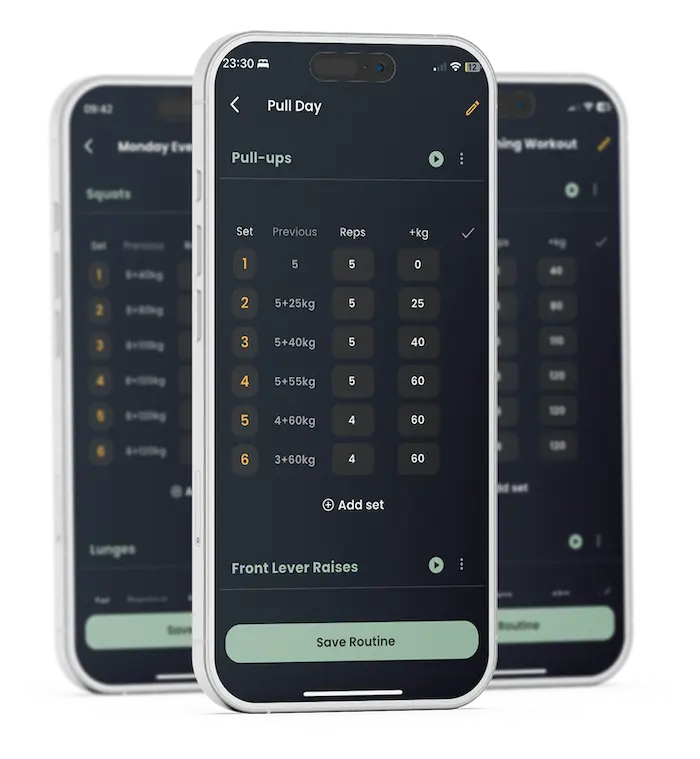
Re-test with a hard set of 3 to 6 reps every few weeks and compare the estimates. The free Calitracker app logs reps and added weight for every set of pull-ups, dips, muscle-ups and 700+ other exercises, and tracks your estimated 1RM automatically on iOS and Android.
This calculator gives an estimate for training purposes and is not medical advice. Warm up properly and use a safe setup before attempting a true maximum.