
Are you ready to start?
You can start handstand practice once your shoulders go fully overhead without pain and your wrists tolerate weight on flat hands. A 30-second plank and a 20-second pike hold on a box are a good test.
- Start when you can do
- Pain-free overhead shoulders and warmed-up wrists
- Typical time
- 2–4 months to first holds
- Arms straight overhead, standing against a wall, without arching your lower back.
- A 30-second plank on straight arms with no wrist pain afterwards.
- A 20-second pike hold with your feet on a box and hips over your hands.
- If any of these hurt, spend two weeks on wrist prep and shoulder mobility first.
The 6 handstand steps
Work at one step until you hit its target on two sessions in a row, then add the next one. Keep the earlier step as a warm-up for a week.
- Chest-to-wall handstand Walk your feet up the wall until your belly faces it and your hands are a hand-width from the wall. Squeeze your legs together, push the floor away and keep your ribs tucked. Move on at3 × 20–30 seconds
- Toe pulls from the wall From chest-to-wall, press through your fingertips until one foot and then both leave the wall for a second or two. This is the balance you will use later. Move on at5 controlled toe pulls
- Bailing Learn to fall before you need to. Turn one hand and step out sideways into a cartwheel, on grass or a mat, until it happens without thinking. Move on atSafe exit every time
- Back-to-wall handstand Kick up with your back to the wall, then tap your heels off it and try to stay up. Hands about 15 cm from the wall. Move on at3 × 20–30 seconds
- Kick-up to balance Kick up in open space with a light, controlled kick. Aim to arrive stacked, not to throw yourself over. Move on atReach balance on most attempts
- Freestanding handstand Hold without support. Balance with your fingers and the heel of the hand, not by bending your arms. Move on atBuild to 30 seconds
A 15-minute handstand routine
Practise 3 to 4 days a week at the start of a session, while you are fresh. Short, frequent sessions build balance faster than one long weekly one.
| Exercise | Sets |
|---|---|
| Wrist prep | 2 minutes |
| Chest-to-wall hold | 3 × 20–30 seconds |
| Toe pulls from the wall | 5 reps |
| Kick-up attempts in open space | 10 attempts, rest as needed |
| Hollow body hold | 3 × 30 seconds |
Mistakes that slow people down
- Banana back. If your lower back arches, your ribs are flared. Tuck the ribs and squeeze your glutes until your body makes one line.
- Hands too far from the wall. On chest-to-wall, more than a hand-width away puts your shoulders in front of your hands and makes the hold harder than it needs to be.
- Kicking too hard. Most failed kick-ups go over the top. A smaller kick that arrives slowly is easier to save.
- Balancing with bent arms. Lock the elbows and correct with your fingers. Bent arms tire you out in seconds.
- Practising tired. Balance falls apart at the end of a hard workout, so put handstands first.
How long does it take to learn a handstand?
With 3 to 4 short sessions a week, most adults reach their first freestanding holds of a few seconds in about two to four months. A hold you can hit on most attempts usually takes several more months.
Gymnastics or yoga experience shortens this. Missing weeks lengthens it more than anything else, because balance fades faster than strength.
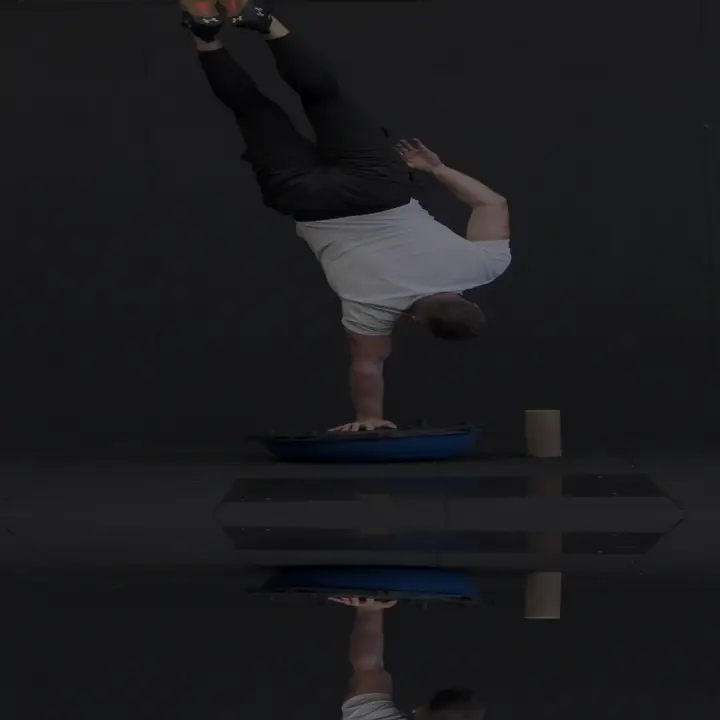
Learn it with a world record holder
Calitracker Premium includes Handstand Fundamentals, a beginner handstand program by Marius Praniauskas, who holds four Guinness World Records for handstands. It takes you from wall drills to your first freestanding hold, and you log every hold so you can see your times grow.
Get the programCommon questions
How often should I practise handstands?
Three to four times a week for 10 to 15 minutes. Balance improves with frequent practice more than with long sessions.
Should I learn chest-to-wall or back-to-wall first?
Chest-to-wall. It teaches the straight body line and is easier to exit safely. Back-to-wall comes later, for practising balance.
Why do my wrists hurt in a handstand?
Usually because they are not used to the load yet. Warm them up for two minutes before every session, spread your fingers wide and build hold times slowly.
Can I learn a handstand at home?
Yes. You need a clear wall and some floor space. Practise bailing on a soft surface before you kick up away from the wall.
Sources
- Freestanding handstand progressions and practice frequency. gmb.io.
- Wall handstand stages and hold targets. r/bodyweightfitness Recommended Routine.
- Marius Praniauskas, four Guinness World Records for handstands. Guinness World Records.
This guide is general training information, not medical advice. Stop if a movement causes joint pain, and build up wrist and elbow loading gradually.