
The short version
- The median workout lasts 48 minutes and has 5 exercises and 17 sets.
- 3 sets per exercise is by far the most common choice.
- Pull-ups, push-ups and dips are the most logged exercises. Each is logged by about 40% of people.
- The typical best set is 10 pull-ups, 15 push-ups and 10 dips.
- 43% of workouts include at least one set with added weight.
- 45% of workouts that kept the app's automatic name were done in the morning.
How long a workout lasts
Half of all timed workouts last between 32 and 70 minutes, and the median is 48. Short and long sessions are both common: about one in five finishes in under half an hour, and one in eight runs past 90 minutes.
The median workout has 5 exercises (half have 4 to 7) and 17 working sets (half have 11 to 24). If your sessions take 30 minutes, you are not doing too little. Plenty of people here train that way and keep at it.
How many sets per exercise
3 sets is the default for most people, and half of all exercises get 3 or 4.
The most logged exercises
The basics lead, with pike push-ups close behind. 80 of the 219 people (37%) logged a handstand, planche, front lever, L-sit or muscle-up exercise.
Typical numbers: reps
Each person's best set without added weight or a band, then the median across people, shown as the best set. The middle half is where half of everyone falls. Someone outside it isn't doing anything wrong; that range is just where most people are.
| Exercise | Best set | Middle half | People |
|---|---|---|---|
| Pull-ups | 10 | 6 to 11 | 86 |
| Chin-ups | 8 | 6 to 10 | 34 |
| Push-ups | 15 | 10 to 20 | 84 |
| Diamond push-ups | 10 | 8 to 15 | 35 |
| Dips | 10 | 8 to 15 | 68 |
| Pike push-ups | 8.5 | 6 to 11 | 74 |
| Australian rows | 13 | 10 to 15 | 39 |
| Pistol squats (per leg) | 8 | 5 to 10 | 31 |
| Handstand push-ups | 4 | 3 to 8 | 11 |
| Muscle-ups | 3 | 2 to 4 | 18 |
These are people who already track their training, so they are stronger than the average beginner. If you are just starting, compare yourself with the strength standards instead: calisthenics strength standards.
Typical numbers: holds
Same method, in seconds. The best hold is the longest single set someone logged.
| Hold | Best hold (s) | Middle half (s) | People |
|---|---|---|---|
| Handstand (freestanding) | 26.5 | 8 to 30 | 20 |
| Chest-to-wall handstand | 30 | 20 to 35 | 11 |
| Planche lean | 20 | 12 to 25 | 24 |
| Tuck planche | 10 | 7 to 14 | 21 |
| Tuck front lever | 15 | 9 to 17 | 21 |
| Advanced tuck front lever | 13 | 10 to 15 | 10 |
| L-sit | 15 | 10 to 20 | 36 |
| Dead hang | 40 | 30 to 55 | 31 |
| Hollow body hold | 30 | 30 to 42 | 45 |
| Plank | 60 | 30 to 70 | 43 |
Most skill holds sit between 10 and 20 seconds. That fits the usual rule of moving to the next step once you can hold the current one for 10 to 15 seconds with good form, which is the target the progressions page uses: calisthenics progressions.
Added weight and bands
- 43% of workouts (1,031) include at least one set with added weight, and 133 of the 219 people (61%) added weight at some point.
- The heaviest weighted pull-up per person has a median of 15 kg added (half fall between 10 and 30 kg, 25 people).
- The heaviest weighted dip has a median of 15 kg added too (half between 9 and 25 kg, 35 people).
- 19% of people (41) mix in gym machines or cable work. It shows up in 5% of workouts.
- 16% of people (36) logged band-assisted sets, mostly pull-ups and skill holds.
Weighted calisthenics is normal here, not a niche. To find a working weight from a set you did, use the weighted pull-up calculator or the weighted dip calculator.
When people train
Workouts that keep the app's automatic name ("Monday Morning Workout") record the day and time of day on the phone. 544 workouts kept that name: 45% were in the morning, 28% in the afternoon and 27% in the evening.
No day stands out much. Tuesday is the quietest, and weekends are as busy as Monday. People who shared workouts over at least 4 weeks (76 people) posted a median of 2.4 workouts a week, and half posted between 1.4 and 3.7. Not every workout gets shared, so real training frequency is probably a bit higher.
What surprised us: best sets often stay flat
15 people logged pull-ups without weight across at least 6 weeks. Their median best set was 10 in the first two weeks and 10 in the last two. Only 4 of the 15 beat their early best. Push-ups and dips looked the same.
That doesn't mean they didn't get stronger. Most people repeat the same rep target instead of testing a max, and some moved to harder variations or added weight. But if you want to see progress in your log, test a max set every 4 weeks, or add a rep or a little weight whenever you hit the top of your rep range.
Track your own numbers
Calitracker is free on iOS and Android. Log reps, holds, bands and added weight, and see your best sets over time.


Free · No ads · iOS and Android
What this data can't tell you
- How long a skill step takes. We wanted to show the time from tuck to advanced tuck front lever, but only 2 people logged both. We will add it when there is enough data.
- Strength by bodyweight, age or sex. Workout posts don't include them, so these numbers are not standards for your bodyweight.
- Everyone who uses the app. People who share workouts are the most active users, so they train more and lift more than the average person.
How we got these numbers
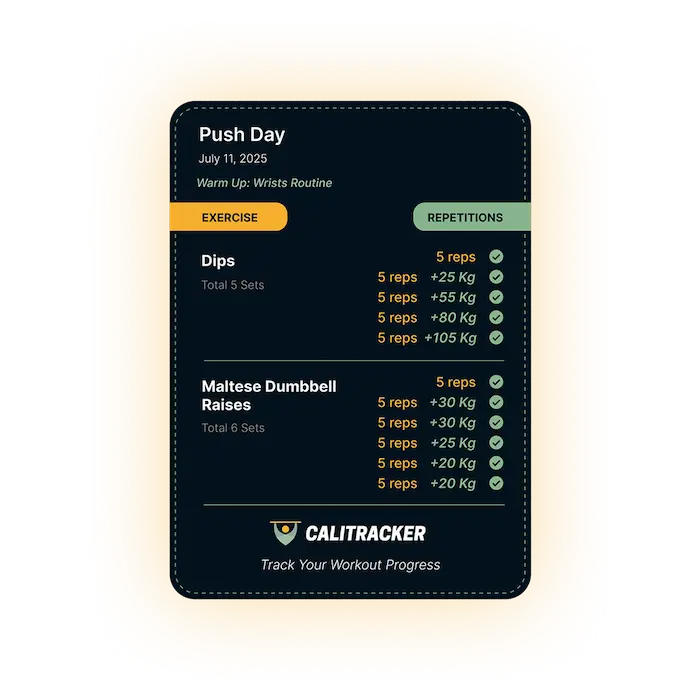
- Source: every workout shared to the public Calitracker community feed from 16 December 2025 to 25 October 2026. 2,402 workouts from 219 people; 75 of them shared 10 or more.
- Reps and holds are counted per person: each person's best set, then the median across people. Without this, one person who logs a handstand every day would outweigh everyone else (handstand holds have 333 entries from just 20 people).
- Sets with added weight or a band are left out of the rep and hold tables. Exercises logged by fewer than 10 people are left out.
- Workout length uses the app's timer and leaves out sessions shorter than 5 minutes or longer than 4 hours, which are usually a forgotten timer.
- No names or profiles are shown, and nothing here can be traced to one person.
Common questions
How long is the average calisthenics workout?
In 1,689 timed workouts logged in Calitracker, the median was 48 minutes. Half lasted between 32 and 70 minutes.
How many pull-ups can most people who train do?
Among 86 people who logged pull-ups, the typical best set was 10, and half fell between 6 and 11. These people already train, so the general population is lower.
How long can most people hold a handstand?
Among 20 people who logged freestanding handstand holds, the typical best hold was 26.5 seconds, and half fell between 8 and 30 seconds.
How many sets per exercise do people do?
3 sets is the most common, at 37% of all logged exercises. Half of all exercises get 3 or 4 sets.